Folks tend to think of themselves in terms of the family name – in our case Malinowski. BUT that is only 1/2 of the story. Great Grandmother Anna Skinder Malinowski is an equal part of our heritage. I realized this week that I have not shared enough on this site about her & the heritage she brings to the family. So I will share some of what I have gathered. Let me start with a note from my sister Kathy talking about her discussion with our grandmother (Gran) Sophia Malinowski Davidson.
From Kathy Airhart Wong – “I remember I was just a little girl when Gran told me, in a very serious way, “You know, Kathy, my grandmother was Jewish.” When I grew up and did a little research, I found that, among Orthodox Jews, a child was Jewish if their mother was Jewish. It made me think that Gran wanted me to know and remember this part of my heritage, as I was in the direct female line.
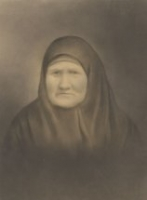
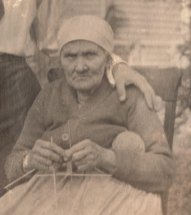
You are familiar with the picture of the woman with the black headscarf, which we have always been told was Rose Skinder. Her maiden name was Bankowski and her mother’s maiden name was Janutowicz. As you know, spellings vary a great deal, but names ending in -witz are very common Jewish names. I had always assumed Anton Skinder was Catholic, but a Jewish acquaintance who I shared the name with on one occasion said she considered it a Jewish name. I have seen the name “Shinder” as a Jewish name, and it is also possible that the spelling was changed.
On the Malinowski Clan page there is huge amount of information, but no comment on religion except that everyone seemed to be a member of St. Hedwig’s. It does show the problem with spelling, much of which may be related to bad penmanship. It would not surprise me if it was considered an embarrassment that Rose was of Jewish background.
You may also remember that although the pictures of Rose Skinder do not show her in the full Jewish head scarf, she never showed her hair. She always wore a “Rosie the Riveter” type head scarf that completely covered her hair. I always assumed that although she was married into a Catholic family and may have converted, she respected the Orthodox tradition she was raised to follow.
Fun things to think about. All I know for sure is that for an orthodox Jew and a Catholic to marry in the mid 1800’s was unheard of and probably a big scandal!
K.
>>>>>>>>>>>>>>>>>>
Skinder family Numbers by area
| Place | Incidence | Frequency | Rank in Area |
|---|---|---|---|
| Poland | 377 | 1:100,819 | 15,369 |
| Russia | 283 | 1:509,269 | 46,754 |
| Belarus | 251 | 1:37,853 | 6,532 |
| Lithuania | 144 | 1:21,074 | 3,817 |
Poland/Lithuania in the Family History
Grynciske is the place of birth Veronica (Vera) Skinder Zukowski (Anna Malinowski’s younger sister) entered on her mother’s, Rosa Skinder, death certificate. (We can find no record of a town spelled this way but there is Grinkiškis. Before WW I it was called Grinkishki, and was part of the Russian Empire.)
Soph Davidson believed Anna’s, her Mother’s, birthplace was Vilna. A couple of possibilities occur to me: 1. The shtetls referred to in the piece below could be a factor. Perhaps Grynciske was a shtetl of Vilnius (called Vilna by the Russian and Jewish communities.) or 2. The family moved from Grynciske to Vilna before the children were born and the name or spelling of the community has changed over the years.
A brief history of Poland in the last 200 years
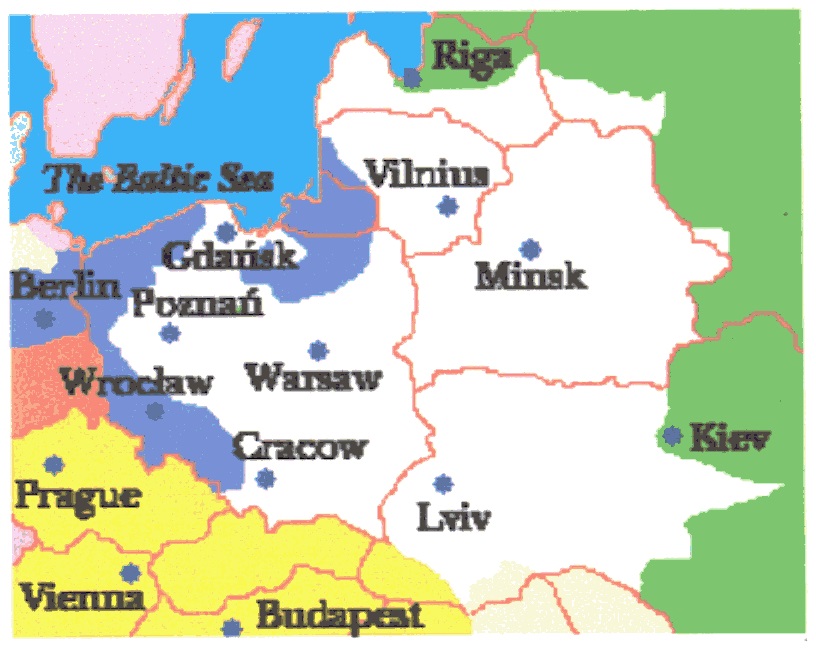
The map of Central Europe in 1772. The Kingdom of Poland is marked in white; Russia -in green, Austria -in yellow and Prussia -in blue. Present- day political boundaries are shown as red lines. Present names of cities are also given.
During the second half of the 18th century the Kingdom of Poland was a country, which differed from present-day Poland in many important ways. Its territory included all of what we now call Lithuania, Belarus and half of contemporary Ukraine. On the other hand, nearly half of the contemporary area of Poland then belonged to Prussia (or, less precisely -to Germany). From time immemorial diverse peoples of several religions had inhabited all those territories. The western and central regions of the Kingdom were inhabited mostly by Catholics of Polish ethnic background. Catholic Poles and Lithuanians lived in its northeastern section, which is now the Republic of Lithuania. The eastern regions were inhabited by Byzantine Catholics of Ruthenian (which is now Belarussian and Ukrainian) background and a small but important Catholic Polish minority. All parts of the Polish Kingdom were also inhabited by Jews (about 10% of the whole population) who lived mostly in shtetls, i.e. tiny cities. Also other ethnic groups, e.g. Germans, Armenians, Tartars, Scots, Dutchmen, etc. were represented. The Prussian provinces of Pomerania, and East Prussia which now belong to Poland also had a considerable Polish minority, although the majority was of German ethnic background. Pomerania and East Prussia were traditionally Lutheran, whereas most of the Silesian people belonged to the Roman Catholic Church.
Jewish Community of Vilna
Vilna, In Lithuanian Vilnius, in Polish Wilno, in Russian Vilna, in Yiddish Vilne, capital city of Lithuania. From 1323 capital of the Grand Duchy of Lithuania, between the two World Wars, a district town in Poland, then capital of the Lithuanian S.S.R. from 1940 until 1991. Called by East European Jewry, especially in the modern period, the “Jerusalem of Lithuania” (Yerushalayim de-Lita).
Early History
The first information of an organized Jewish community in Vilna dates from 1568, when it was ordered to pay the poll tax. In February 1633 the Jews of Vilna were granted a charter of privileges permitting them to engage in all branches of commerce, distilling, and any crafts not subject to the guild organizations, but restricting their place of residence in the city. During the first half of the 17th century the Vilna community was augmented by arrivals from Prague, Frankfort, and Polish towns, who included wealthy emigrants and scholars. In this period about 3,000 Jewish residents are recorded out of a total population of some 15,000. Although the Vilna community, now an important Jewish entity, claimed the status of a principal community, or “Community Head of the Courts” (Kehillah Rosh Beth Din), within the organizational framework of the Council of Lithuania (Vaad Lita), the status was not conceded until 1652. During the uprising against Russia in 1794 a number of Vilna Jews demonstrated their loyalty to Poland in the fighting and the Kahal made contributions to the participants in the uprising. After the conquest of the city by the Russians, however, the Jewish position in commerce and crafts improved.
Leave a Reply